

PRESS RELEASE – For Immediate Release
East Turkistan Government in Exile (ETGE)
East-Turkistan.Net
contact@East-Turkistan.Net
21 July 2025
Washington, DC — On Monday, July 21, 2025, a Congressional Briefing on Captive Nations was convened in the Rayburn House Office Building of the U.S. Congress to commemorate Captive Nations Week 2025, established under Public Law 86-90, the Captive Nations Resolution. The event gathered representatives from East Turkistan, Tibet, Southern Mongolia, US national security experts, and Congressional staff to address the ongoing occupation, repression, and erasure endured by these nations.
Enacted in 1959, the Captive Nations Resolution (Public Law 86-90) identifies nations subjugated by communist imperialism, calling for US support to restore their liberty and independence. It explicitly mentions captive nations, such as Turkistan and Tibet, urging support for their liberation and the right to self-determination.
Salih Hudayar, Minister of Foreign Affairs and Security for the East Turkistan Government in Exile, delivered a compelling keynote address, stating, “East Turkistan was explicitly named in the 1959 Captive Nations Resolution, not as part of China, but as a nation subjugated by Communist imperialism.” He added, “That law remains in force. And tragically, so too does our captivity.”
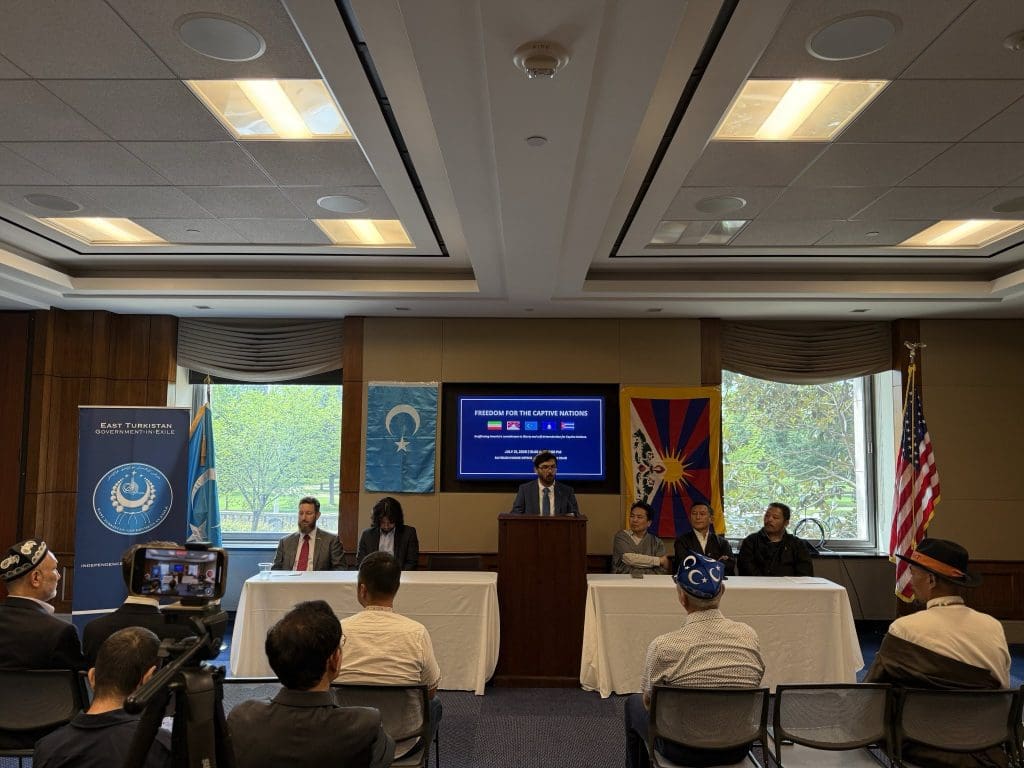
Hudayar detailed an ongoing genocide, noting, “Millions have been locked in concentration camps and prisons… the separation of over one million children from their families,” and cited 2024 Congressional testimony revealing that “between 25,000 to 50,000 Uyghur and Turkic youth are killed annually so their organs can be sold.”
He criticized Türkiye’s collaboration with Chinese intelligence to suppress East Turkistani independence and warned of the Chinese Communist Party’s (CCP) ongoing efforts to “divide and co-opt Uyghur organizations abroad.” Hudayar urged Congress to recognize East Turkistan as an occupied nation, conduct hearings on East Turkistan’s struggle for independence, and investigate and stop Chinese infiltration and transnational repression in the East Turkistani/Uyghur diaspora.
He concluded, “Removing the CCP is not enough. The Chinese empire must be dismantled. The restoration of liberty and independence for East Turkistan is not a dream. It is a duty enshrined in the Captive Nations Resolution.”
Tenzin Wangdu, a Tibetan-American representative of the Tibetan Rangzen [independence] movement, emphasized Tibet’s distinct identity, stating, “Tibet has never legally been a part of China… We had our own government, our own culture, our distinct identity for over a thousand years.”
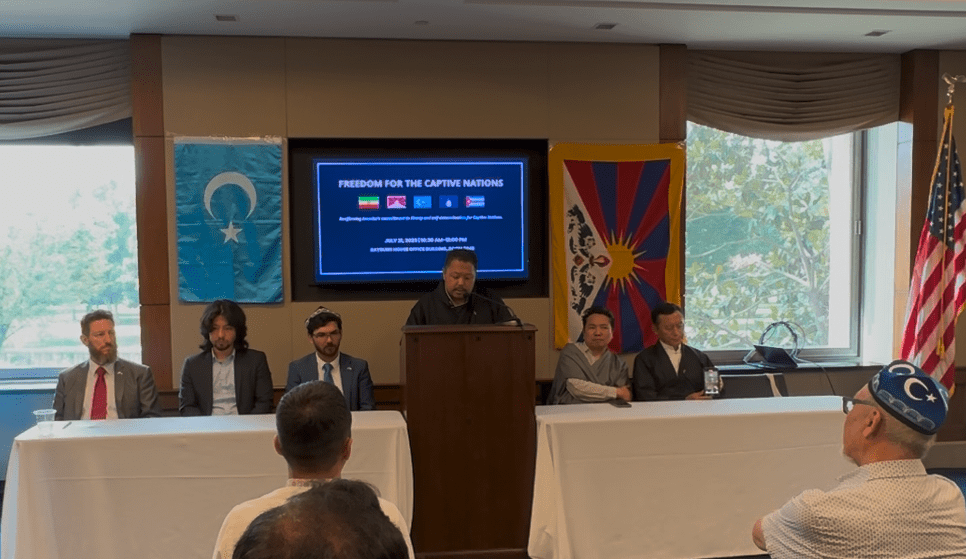
He declared, “The Chinese occupation of 1951 was an invasion and not a liberation… The time for empty statements is over. We need concrete action.”
Wangdu stressed that only independence can ensure the survival of the Tibetan people.
Se Hoon Kim, a Korean-American journalist, issued a statement on behalf of the Southern Mongolian community, highlighted the systematic erosion of Mongolian identity, stating, “For decades the Mongolian people of Southern Mongolia have faced systematic efforts to erode their cultural identity, suppress their language, and marginalize their traditional way of life… What we are witnessing is not merely a crackdown, it is a deliberate assimilation that threatens the survival of an ancient heritage.”
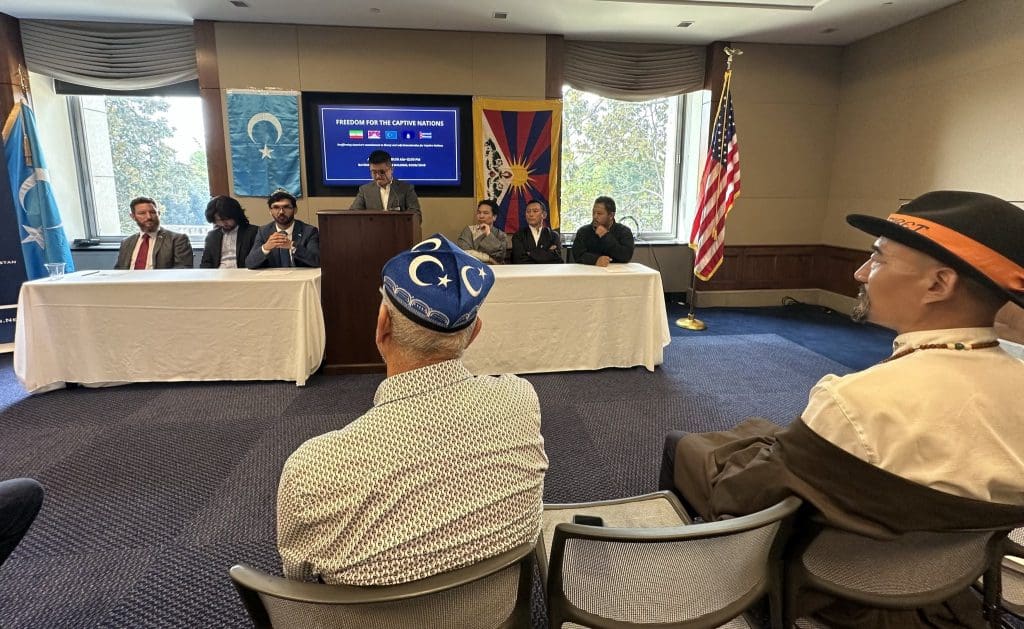
He also drew attention to authoritarian repression in nations like Iran and Cuba, underscoring the global fight against dictatorships and political oppression. Kim further called on the United States to acknowledge and address the plight of Southern Mongolia and other oppressed peoples.
Major Ben Lowsen (Ret.), a former US Army attaché in Beijing, underscored the global reach of CCP threats, warning, “The attack of the Chinese Communist Party on the United States is proceeding as quickly as the CCP can facilitate and as we will allow.”
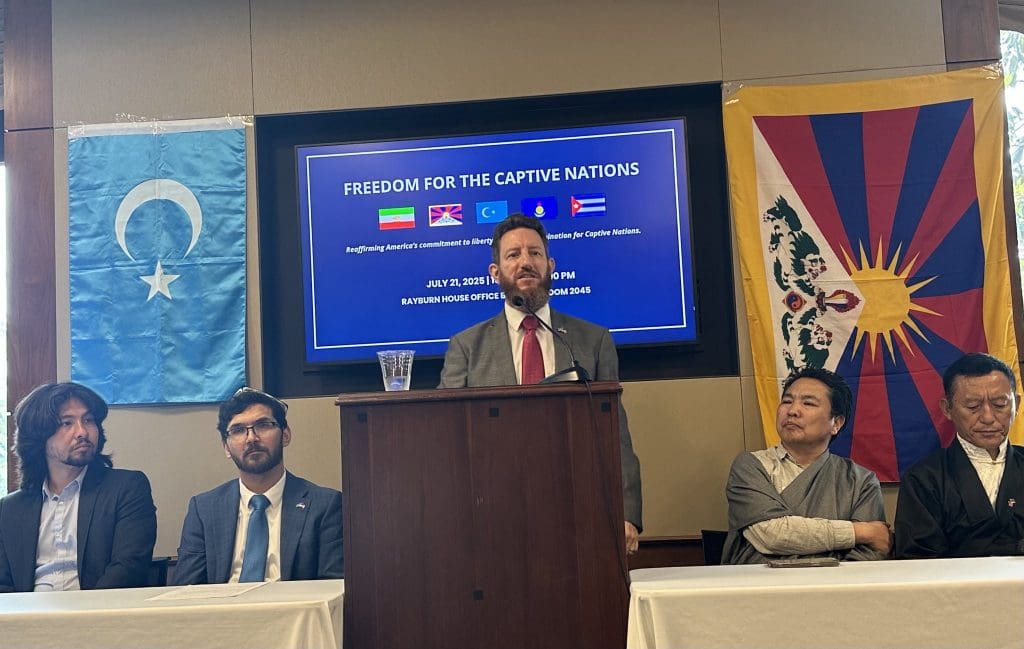
He further called on the US government to prioritize the liberation of captive nations, stating, “We need to establish an office of East Turkistan affairs… fund warfare, frankly, the political warfare that the CCP is funding against us.”
The briefing concluded with a Joint Statement and Proclamation from representatives of East Turkistan, Tibet, Southern Mongolia, and other oppressed peoples, declaring: “The right of all captive nations to recover their independence and exercise national sovereignty is absolute and non-negotiable.” They affirmed, “We will not cease our efforts until independence is restored, liberty is secured, and justice is achieved for all captive nations.”
The event underscored the urgent need for international action to address the systemic oppression faced by these captive nations and their pursuit of national self-determination and independence.